


When Hormuz Closes: How a Military Escalation in Iran Rewires Global Oil and Products Trade
Enerdealers Editorial
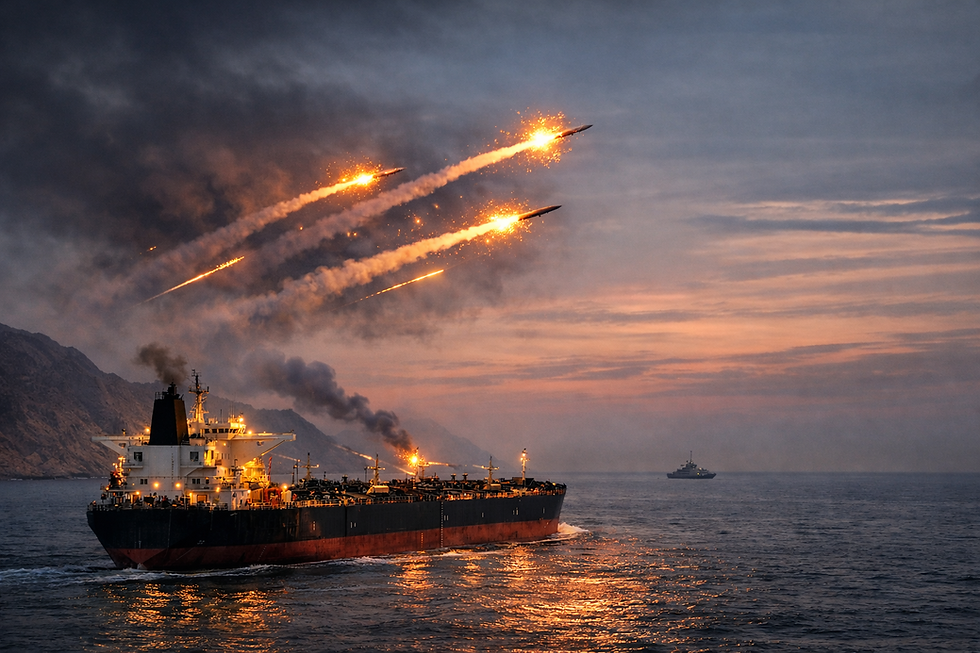
From Chokepoint to Shockpoint
The closure of the Strait of Hormuz during a military intervention in Iran is the nightmare scenario that the oil market has rehearsed for decades but never fully lived. Around a fifth of global oil and gas flows move through this two‑mile‑wide shipping lane, making it the single most critical maritime chokepoint in the hydrocarbon economy. A full shutdown would not just push crude benchmarks higher; it would reorder trade flows for crude, refined products and LNG, strain shipping and insurance, and expose which regions are structurally under‑hedged against Middle East disruption.
For traders, buyers and decision‑makers, the question is no longer theoretical. The current confrontation around Iran, involving direct US threats of military action and Iranian drills and partial closures in the Strait, has already prompted some shipowners and oil companies to suspend shipments through Hormuz and reroute tankers, even before a formal blockade. In a scenario where military escalation leads to an effective closure of the Strait—whether through mines, missile threats or insurance‑driven self‑sanctioning—the impact on global oil and products trading would be immediate, uneven and deeply political.
This article looks at what is at stake in volumes, which origins and destinations are most exposed, how trade routes and price structures would likely adjust, and where physical shortages are most probable if the Strait stays closed beyond a few weeks.
More than 80% of oil exports through the Strait end up in Asia, with China the single largest buyer, followed by India, South Korea and Japan.
How Much Supply Is at Risk?
The Strait of Hormuz connects the Persian Gulf with the Gulf of Oman and the Indian Ocean, serving as the sole maritime outlet for the oil and LNG exports of Saudi Arabia’s eastern fields, Iraq’s southern terminals, Kuwait, Qatar, the UAE’s main Gulf ports, and Iran itself. Estimates vary, but recent analyses suggest that roughly 20–20+% of global oil supply and around 20% of global LNG trade transit Hormuz in normal conditions.
A 2026 market note from a European broker put the crude and condensate flow at about 13–14 million barrels per day—roughly 35% of global seaborne crude trade—much of which cannot be easily rerouted. The US Energy Information Administration (EIA) has also highlighted that in 2024 Qatar exported around 9.3 Bcf/d of LNG through Hormuz and the UAE about 0.7 Bcf/d, accounting for nearly all LNG flows from the Persian Gulf to global markets. More than 80% of oil exports through the Strait end up in Asia, with China the single largest buyer, followed by India, South Korea and Japan.
In other words, a full closure locks in:
A low‑ to mid‑teens million b/d crude and condensate stream.
Several million b/d equivalent of refined products (gasoil, jet, gasoline, fuel oil, naphtha).
About one‑fifth of global LNG supply, predominantly Qatari cargoes bound for Asia.
Not all this volume is irretrievable. Some Gulf producers have invested in bypass routes—Saudi east‑west pipelines to the Red Sea, the UAE’s Abu Dhabi Crude Oil Pipeline (ADCOP) to Fujairah, Iraqi exports via Turkey, and non‑Hormuz LNG routes from other suppliers. A recent risk assessment estimated that roughly half of crude oil exports from Gulf littoral states can now use alternative routes, which moderates the worst‑case volume loss but still leaves a significant shortfall and higher costs.
Europe receives smaller direct volumes, but its exposure is indirect through higher global benchmarks and competing Atlantic Basin flows.
Crude Oil: Origins, Alternatives and New Flows
Who Loses Barrel‑for‑Barrel?
The most directly affected crude exporters via Hormuz are:
Saudi Arabia: the largest user of the Strait, accounting for nearly 40% of its crude exports.
Iraq: especially from Basra and other southern terminals.
UAE and Kuwait: heavily reliant on Gulf ports, though the UAE can partially bypass Hormuz.
Qatar and Iran: for condensate and crude shipments.
Most of these barrels are medium to heavy sour grades central to Asian refiners’ slates. More than four‑fifths of crude leaving Hormuz heads east to buyers in China, India, Japan and South Korea. Europe receives smaller direct volumes, but its exposure is indirect through higher global benchmarks and competing Atlantic Basin flows.
Bypass Infrastructure: How Much Can Actually Move?
Alternative routes offer partial relief:
Saudi East–West Pipeline (Petroline): Moves crude from eastern fields to Red Sea ports, allowing exports to Europe and North America without Hormuz. Capacity has been expanded in recent years, but it cannot fully replace all Saudi volumes normally exiting via the Gulf.
UAE ADCOP to Fujairah: Allows Abu Dhabi crude exports from the Gulf of Oman, outside Hormuz. This line can handle a significant share of the UAE’s output, but not all of it.
Iraq–Turkey pipeline (Kirkuk–Ceyhan): Provides a northern outlet for some Iraqi crude, although geopolitical and technical disruptions have historically constrained flows.
Even with all bypass capacity fully utilized, current assessments suggest only about half of Gulf crude export volumes have viable alternative routes, leaving several million barrels per day effectively stranded if the Strait is considered unsafe. This is before considering that pipelines and Red Sea terminals may themselves become targets or face operational bottlenecks in a high‑risk environment.
How Trade Flows Rewire
In a sustained closure, crude trade would re‑orient along a few predictable lines:
Atlantic Basin crude into Asia: West African, North Sea, Brazil, Guyana and US Gulf Coast crudes would increasingly flow east to partially replace lost Arab Gulf barrels, at the cost of higher freight and potentially different quality fits.
Middle East barrels prioritized by politics: Remaining Saudi/UAE volumes that can move via the Red Sea and Fujairah would likely be directed first to strategic partners and long‑term contract buyers, tightening spot availability and forcing others to rely on spot West African and US barrels.
Regionalization of flows: Asia leans more heavily on Russia, West Africa, the US and Latin America; Europe draws more from the US, West Africa and the North Sea, while Middle East volumes that do move may be directed selectively to premium markets.
For refiners, the quality mismatch matters as much as volume. Many Asian plants are optimized for medium sour grades from Saudi Arabia, Iraq and Kuwait. Replacing them with lighter US or North Sea grades changes yield structures and relative margins for gasoline, middle distillates and fuel oil.
The Gulf is not just a crude exporter; it is a growing hub for refined products.
Refined Products: From Arabian Jet and Gasoil to Global Shortage
What Products Normally Move Through Hormuz?
The Gulf is not just a crude exporter; it is a growing hub for refined products. Saudi Arabia, Kuwait, the UAE and Qatar have invested heavily in large, complex refineries capable of exporting:
Gasoil and diesel into East Africa, Asia and Europe.
Jet fuel into Asian and European hubs.
High‑sulfur fuel oil and low‑sulfur blends for bunkering in Singapore and Fujairah.
Naphtha and LPG for Asian petrochemical producers.
A closure of Hormuz interrupts:
Product flows from Saudi east‑coast refineries serving Asia.
Exports from Kuwait and Qatar to Asia and Africa.
UAE product exports and bunkering roles, especially from Gulf ports, although Fujairah is located outside the Strait and would remain accessible if internal UAE links are secure.
Regional Impacts on Products
For product traders, the effects differ by region and barrel:
Asia: Faces shortages of middle distillates (gasoil, jet) and some gasoline grades that normally arrive from Gulf mega‑refineries. Chinese and Indian exports may increase, but this competes with domestic needs and policy priorities.
Europe: Already structurally short in diesel, Europe relies on imports from Russia (now constrained), the US, and increasingly the Middle East. Loss of Arabian diesel exports via Hormuz tightens European gasoil balances further, boosting arbitrage from the US Gulf and India.
Africa: East Africa in particular, which is heavily dependent on Gulf product imports, is exposed to supply breaks and price spikes, with limited refining back‑up.
Bunkering hubs: Singapore, already dealing with elevated freight and risk premia in the region, would pay more for fuel oil and marine gasoil, while Fujairah’s role as a bunkering hub outside Hormuz becomes even more strategic.
Refining systems in Europe, India, China and the US would respond by:
Maximizing runs where economics allow.
Tweaking crude slates to produce more middle distillates.
Shifting internal product flows (e.g., more US diesel to Europe, more Chinese gasoil to Southeast Asia) and exploiting price differentials.
But structural diesel and jet tightness is likely to persist as long as Middle Eastern exports are constrained.
LNG and Gas: Asia’s Achilles’ Heel
The LNG story is critical for Asian buyers. In 2024, about 20% of global LNG trade passed through the Strait of Hormuz, largely from Qatar, with smaller volumes from the UAE. Around 83% of these flows went to Asian markets, with China, India and South Korea accounting for more than half of all LNG volumes exiting through the Strait.
A prolonged closure immediately threatens:
Qatari contract deliveries to Northeast Asia and India.
Flexible cargoes re‑directed from Europe to Asia.
Regional spot liquidity, especially in the Pacific basin.
The rebalancing options are limited:
Europe can partially draw more pipeline gas (where available) and LNG from the US and West Africa, but this leaves less flexibility to backfill Asia.
Asia must bid aggressively for US Gulf, Australian, West African and East Mediterranean LNG, pushing spot prices higher and potentially forcing demand destruction in price‑sensitive markets.
Given the scale of Qatari supply, a full loss is unlikely in political terms; more plausible is a mix of reduced flows, high war‑risk premiums and occasional physical disruption. But even this is enough to trigger price spikes and structural repricing of LNG contracts indexed to oil and spot benchmarks.
Shipping, Insurance and Logistics: Invisible Barrels Lost
Even short of a literal “blockade,” heightened military activity in Hormuz has already led some shipowners and trading houses to suspend or divert shipments due to security concerns and spiralling insurance costs. Lloyd’s‑type war‑risk premiums for tankers transiting the Strait would surge, with several consequences:
Effective capacity loss: A portion of the global tanker fleet becomes unavailable for Gulf voyages, either because owners refuse to sail or charterers cannot afford the risk premium.
Longer routes: Rerouted cargoes (e.g., Atlantic to Asia) tie up tonnage for longer voyages, tightening the tanker market and pushing freight higher.
Operational delays: Convoy systems, naval escorts and re‑routing increase days‑on‑water, effectively reducing available supply even if volumes at origin remain the same.
A European brokerage has warned that a complete closure of the Strait would create a “chaotic situation” in which a large share of the tanker fleet is effectively out of business, emphasizing that the mere threat has already raised war‑risk premiums that will be passed on to charterers. In practice, this means that even barrels which can move will arrive more slowly and at a higher delivered cost.
Refinery margins in less exposed regions (US Gulf, Europe’s Atlantic coast, some Asian inland refineries) would likely strengthen, incentivizing higher runs and exports.
Prices and Spreads: How the Market Would Reprice Risk
Benchmarks: Brent, Dubai and Regional Grades
In a full closure scenario, markets would likely see:
Sharp spikes in Dubai and Oman benchmarks due to direct Gulf exposure, with Brent and WTI following but possibly at somewhat lower relative increases if Atlantic supply remains accessible.
Wider Brent–Dubai spreads, reflecting scarcity of Middle Eastern sour barrels for Asia and a premium on non‑Gulf sour grades (e.g., from Russia, West Africa).
Elevated backwardation across the crude curve as prompt scarcity and inventory draws dominate.
In previous regional disruptions, analysts have often found that the impact on benchmark prices depends heavily on macro conditions: global demand, inventory levels and available spare capacity. Today’s lower spare capacity outside the Gulf magnifies the price impact.
Product Spreads and Crack Margins
Product markets would respond with:
Higher middle distillate cracks (gasoil, jet) as structural shortages develop in Europe, Asia and Africa.
Stronger gasoline cracks in regions dependent on Middle Eastern blending components and motor fuel exports.
Regional dislocations in fuel oil: Singapore and Fujairah bunker markets would see higher premiums; constraints on high‑sulfur fuel oil flows could also affect power and shipping in emerging markets.
Refinery margins in less exposed regions (US Gulf, Europe’s Atlantic coast, some Asian inland refineries) would likely strengthen, incentivizing higher runs and exports.
Volatility and Storage
The combination of geopolitical risk, physical constraints and speculative positioning would create extreme volatility:
Intraday moves in crude benchmarks could widen.
Volatility in spreads (time‑spreads, quality spreads and location spreads) would increase as traders reassess which barrels are truly deliverable.
Floating storage might rise wherever security allows, as traders attempt to arbitrage a steeper backwardation or capture optionality, though high freight and war‑risk premiums limit this.
European policymakers and companies will lean more heavily on US, North Sea and West African supplies, while accelerating measures to reduce oil and gas demand where politically feasible.
Global Winners and Losers: Regional Perspectives
Asia: First in the Line of Fire
Asian buyers are the most exposed to Hormuz disruption, since more than 80% of oil exports through the Strait and the bulk of LNG flows are destined for Asian markets. China, India, Japan and South Korea must respond on several fronts:
Crude diversification: Increasing imports from Russia (where possible), West Africa, the Americas and other Middle Eastern suppliers that can bypass Hormuz.
Strategic stock draws: Coordinated releases from strategic petroleum reserves (SPRs) to cover shortfalls and stabilize domestic fuel prices.
Policy flexibility: Relaxing import quotas, adjusting product export policies and potentially tolerating higher domestic prices to ration demand.
Some Asian refiners with diversified crude slates and flexible configurations could benefit from stronger margins, while others face feedstock shortages and higher replacement costs.
Europe: Indirectly Exposed but Still Vulnerable
Europe’s direct reliance on Hormuz crude is lower than Asia’s, but it remains vulnerable through:
Higher global crude benchmarks.
Tighter diesel imports, as Middle Eastern suppliers re‑prioritize and overall exports fall.
LNG competition from Asia, which may price Europe out of marginal cargoes.
European policymakers and companies will lean more heavily on US, North Sea and West African supplies, while accelerating measures to reduce oil and gas demand where politically feasible.
United States and Atlantic Producers: Relative Advantage
Producers in the Atlantic Basin—US, Brazil, West Africa, Guyana—gain relative influence:
US crude and LNG exports become even more central to global balancing, especially for Europe and parts of Asia.
West African grades see stronger demand from Asian refiners seeking sour or medium crudes that resemble Middle Eastern qualities.
Latin American barrels gain premium markets, although internal political and operational constraints limit upside.
However, higher global prices also raise domestic fuel costs and inflation risk, creating political pressure on exporting governments to manage flows carefully.
Potential Supply Shortfalls and Demand Destruction
Even with all bypass routes and spare capacity mobilized, a prolonged Hormuz closure would likely leave a multi‑million‑barrel‑per‑day gap in crude and product supply, alongside a substantial LNG shortfall for Asia. SPR releases can plug part of this gap in the short term, but not indefinitely.
Physical shortages manifest as:
Fuel scarcity in emerging markets with weak credit and limited storage, especially in East Africa and South Asia.
Rolling blackouts or fuel rationing, where oil‑fired power and diesel generators play a major role.
Industrial demand destruction, as higher prices and supply uncertainty lead some consumers to curtail operations.
On the gas side, high LNG prices and limited availability force some Asian markets to switch back to coal or oil for power generation, undermining emissions goals and further tightening oil product markets.
The episode reinforces the value of optionality: diversified books, flexible logistics, access to storage in multiple regions, and robust risk management frameworks for both price and operational risk.
Strategic and Structural Implications for the Energy Trade
Over the medium term, a militarized Hormuz closure would accelerate several structural changes:
Diversification of routes and infrastructure: More investment in pipelines that bypass chokepoints, new export terminals outside the Gulf, and enhanced security for existing routes.
Re‑evaluation of contract structures: Buyers may push for more diversified supply portfolios and destination‑flexible contracts, while sellers seek political guarantees and premium pricing for at‑risk routes.
Shift in geopolitical risk premia: Markets will price in a higher structural risk premium on Gulf barrels and LNG, even after tensions ease, compared to supplies from less exposed regions.
Faster energy transition in some regions: High and volatile fossil fuel prices can accelerate investment in renewables, electrification and efficiency, especially in import‑dependent economies.
For trading houses, the episode reinforces the value of optionality: diversified books, flexible logistics, access to storage in multiple regions, and robust risk management frameworks for both price and operational risk.
Conclusions: Trading in a Fragmented Oil World
A military intervention in Iran that leads to the effective closure of the Strait of Hormuz transforms a long‑recognized chokepoint into a global shockpoint for crude, products and LNG. Between 20% of global oil and gas flows and one‑fifth of LNG trade are directly exposed to this single waterway, and even with alternative routes, the system cannot fully replace Gulf exports in the short term. Asia bears the brunt of lost supply, but Europe and the wider Atlantic Basin feel the impact through higher benchmarks, tighter products markets and stronger competition for LNG.
For market participants, the key is not just predicting price direction but understanding relative dislocations: which grades and products command the highest premiums; which routes and hubs become critical; and where physical shortages drive policy interventions. Gulf producers with bypass infrastructure, Atlantic exporters, flexible refiners and well‑positioned traders will find opportunities, but against a backdrop of heightened operational and political risk.
Even if a diplomatic off‑ramp emerges and traffic through Hormuz resumes, the episode will leave a lasting imprint on how traders and policymakers perceive and price Middle East risk. In a world where a single narrow strait can reshape global flows in days, resilience—geographical, logistical and financial—becomes as important a commodity as the barrels themselves.
Sources
Control Risks, “The Strait of Hormuz: how would a closure impact trade?”[controlrisks]
New York Times, “Iran Holds Exercises in Strait of Hormuz After Trump Threatens Military Action,” 16 Feb 2026.[nytimes]
Energy Analytics Institute citing EIA, “Around 20% of global LNG flows through Strait of Hormuz,” 24 Jun 2025.[energy-analytics-institute]
Investing.com, “What happens to oil if Iran closes the Strait of Hormuz?”, 14 Jan 2026.[investing]
Wikipedia, “2026 Iran–United States crisis.”[en.wikipedia]
Institute for Energy Research, “Persian Gulf Oil Exports and the Strait of Hormuz,” 29 Jun 2025.[instituteforenergyresearch]
Energy Connects, “Explained: why is the Strait of Hormuz so critical for oil markets?”, Feb 2026.[energyconnects]
BBC News, “Strait of Hormuz: What happens if Iran shuts global oil corridor?”, 23 Jun 2025.[bbc]
Zero Carbon Analytics, “Asian countries most at risk from oil and gas supply disruptions in Strait of Hormuz,” Feb 2026.[zerocarbon-analytics]


